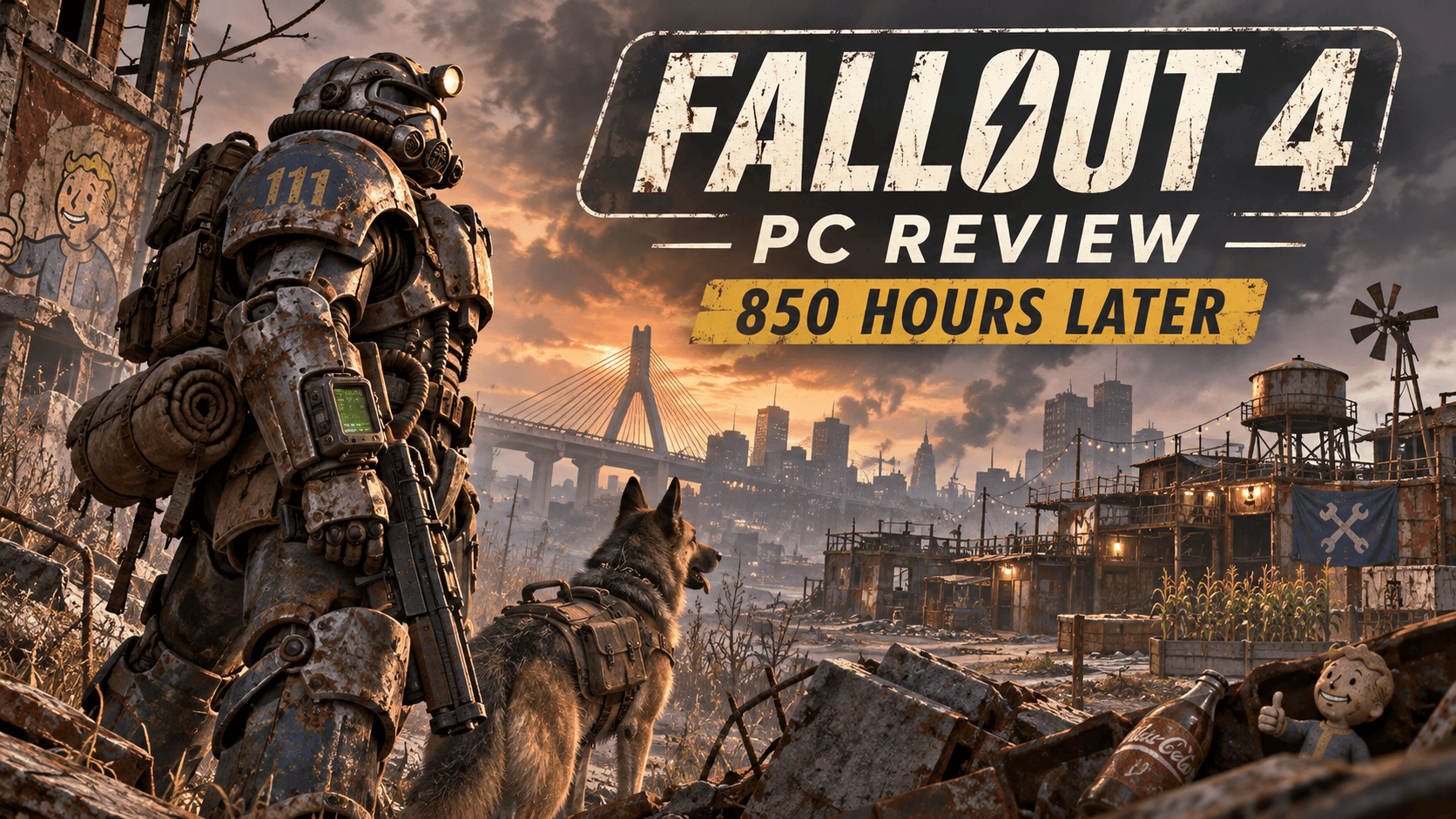

Fallout 4 PC Review: 850 Hours Later, Is It Still Worth Playing?
After spending 850 hours playing Fallout 4 on PC, completing the game, replaying it countless times, and experimenting with mods, I can confidently say this is one of those games I keep coming back to. There’s something ridiculously entertaining about wandering through a post-apocalyptic wasteland, collecting everything that isn’t nailed down, and finding something new to mess around with. Fallout 4 isn’t perfect, and its aging game engine can seriously test your patience, but the amount of freedom it offers keeps me interested.
I’ve spent enough time in the Commonwealth to appreciate its strengths and recognize its problems. From combat and exploration to settlement construction and character development, there’s plenty here to keep players entertained. Modding adds another level of enjoyment, though it can introduce technical headaches that make even experienced PC gamers question their life choices.
My overall rating for Fallout 4 is 8/10. It’s a fantastic open-world RPG with tremendous replay value, held back by technical limitations, some questionable design decisions, and a story that doesn’t consistently match the freedom of its gameplay.
Quick Verdict
Fallout 4 offers an enormous post-apocalyptic playground packed with combat, exploration, customization, and activities. The freedom to approach the Commonwealth at your own pace is one of its strongest qualities. Whether you’re interested in fighting enemies, upgrading equipment, constructing settlements, or discovering locations, there are several ways to enjoy the experience.
My biggest reason for returning is the combination of its open world and modding opportunities. There aren’t many games where I can finish the main story repeatedly and still find reasons to continue playing. Fallout 4 manages that through its different gameplay systems and the creative freedom provided by mods.
Unfortunately, its technological foundation hasn’t aged particularly gracefully. Stability can become troublesome, particularly with large mod lists, and the base game occasionally has problems of its own. Storytelling and dialogue have weaknesses, too.
Verdict: 8/10. Fallout 4 remains an excellent choice for players interested in open-world exploration, combat, customization, and long-term replayability, provided they’re prepared to tolerate occasional technical frustrations.
Fallout 4 Gameplay and Core Mechanics
The main reason I love Fallout 4 is its gameplay variety. I enjoy combat, exploring the Commonwealth, building settlements, developing my character, and experimenting with modifications. These features work together to create a game that doesn’t demand one particular approach.
Fallout 4 Gameplay Highlights
Exploration is easily one of Fallout 4’s greatest strengths. The Commonwealth gives players a huge environment filled with abandoned buildings, settlements, underground locations, hostile creatures, and scattered pieces of pre-war history. Exploration feels like a major part of the experience rather than a distraction from the main quest.
I appreciate having the freedom to explore without feeling pressured to follow a strict sequence of objectives. I can focus on the main story, get distracted by side activities, or spend a session working on something entirely different. That flexibility is one of the reasons I’ve accumulated so many hours.
The game rewards curiosity through loot, equipment, discoverable locations, and environmental storytelling. Even ordinary buildings can contain supplies, enemies, or details about the people who lived there before the nuclear devastation. This gives exploration a purpose beyond simply filling out the map.
Combat, Weapons, and V.A.T.S.
Combat is another part of the experience I enjoy. Fallout 4 combines first-person and third-person shooting with weapon customization, melee combat, explosives, and the familiar Vault-Tec Assisted Targeting System, better known as V.A.T.S.
V.A.T.S. gives combat a distinctive Fallout identity. Players can target individual enemy body parts, manage action points, and use critical attacks. It’s a useful alternative to relying entirely on traditional shooter mechanics.
Weapon crafting contributes to combat variety. Different modifications change weapon characteristics, giving players more control over their equipment and supporting different character builds. Whether someone favors conventional firearms, energy weapons, or close-range combat, the game provides a substantial selection.
Character Progression and Difficulty
Fallout 4’s progression system uses the S.P.E.C.I.A.L. attributes and perk chart to develop a character over time. Players can invest in different abilities, improve combat effectiveness, and gain access to additional gameplay options.
I don’t consider Fallout 4 particularly difficult once you learn its basic mechanics. Getting comfortable with combat, equipment, healing, crafting, and the progression system makes the experience much easier to manage. New players might encounter a learning curve, but the fundamentals are approachable.
The character development system offers a good amount of freedom, though it doesn’t have the same depth in every area as some older role-playing games. Its emphasis on perks and flexible progression works well for my preference for experimentation.
Settlement Building and Crafting
Settlement building is one of Fallout 4’s most recognizable additions to the series. Players can collect resources, construct structures, provide necessities for settlers, and create functional communities throughout the Commonwealth.
I enjoy the creative possibilities that come from settlement construction. It provides something different from combat and exploration, offering a reason to gather resources and spend time developing locations.
The crafting systems connect several activities. Collecting junk can contribute to constructing settlements, improving weapons, and upgrading armor. Suddenly, all those seemingly useless objects have a reason to exist.
Of course, collecting everything has its own consequences. Inventory management can become a regular part of life in the wasteland, particularly for players who can’t resist picking up every useful-looking item.
Graphics and Visual Design
Fallout 4’s visuals have strengths and weaknesses, particularly when judged years after its original release. Its graphics aren’t groundbreaking by modern standards, and certain textures, character animations, and environmental details reveal its age. Still, its overall presentation communicates the ruined atmosphere of the Commonwealth effectively.
One of the game’s strongest visual features is its post-apocalyptic setting. The combination of ruined neighborhoods, industrial sites, decaying infrastructure, and retro-futuristic technology gives Fallout 4 a recognizable identity. Its visual direction does more for the experience than raw graphical fidelity alone.
I consider the graphics good overall, though there are areas that could be better. Character animations and some visual elements don’t feel particularly modern anymore. The world itself remains a major attraction.
Modding gives PC players opportunities to experiment with visual changes. Texture replacements, lighting adjustments, environmental overhauls, and other community-created modifications can change how the game looks. The tradeoff is that visual modifications can increase system demands and create compatibility problems.
Story, Characters, and Worldbuilding
Fallout 4 begins with a powerful premise. Following a catastrophic nuclear attack, the protagonist emerges from Vault 111 into a devastated Commonwealth, searching for their missing son. What follows is a mixture of personal investigation, faction conflict, exploration, and difficult decisions.
The main storyline gives players an identifiable objective, and the different factions add competing interests to the Commonwealth. The Brotherhood of Steel, the Railroad, the Institute, and the Minutemen represent different approaches to the region’s problems. Their disagreements shape much of the game’s narrative.
I consider the story good overall, though I wouldn’t call it flawless. Certain dialogue limitations and role-playing restrictions can make the experience feel less flexible than the exploration and gameplay systems suggest. The voiced protagonist and streamlined conversation choices are particularly noticeable parts of this design.
For a game that gives players such tremendous freedom in exploration and character development, the dialogue system can sometimes feel comparatively restrictive. That contrast is frustrating in an RPG where personal decisions should carry substantial weight.
Fortunately, the Commonwealth contains plenty of storytelling outside the main quest. Environmental details, optional quests, discoverable records, and faction-related content help establish the setting’s history. The game’s worldbuilding remains a major attraction even when the primary narrative isn’t firing on every cylinder.
The story is worth experiencing, but the world surrounding it contributes just as much to Fallout 4’s lasting appeal.
Audio and Sound Design
Fallout 4’s audio presentation fits its setting effectively. Weapons, environmental effects, creatures, dialogue, and music all contribute to the game’s distinctive atmosphere. Its mixture of retro-inspired music and post-apocalyptic sound design reinforces the Fallout identity.
Radio stations are a memorable part of the overall presentation. Diamond City Radio provides a selection of older music that contrasts with the destruction scattered across the Commonwealth. The result is a strangely entertaining combination of cheerful tunes and nuclear devastation.
The ambient soundtrack creates a different experience. It supports exploration and quieter moments, giving locations a sense of atmosphere without relying constantly on dramatic musical cues.
I consider the audio good overall, with room for improvement across the presentation. I wouldn’t describe every performance or sound effect as exceptional, but the audio direction contributes positively to the experience.
Fallout 4 PC Performance and Technical Stability
Technical performance is one of the areas where my opinion becomes more critical. Fallout 4 is built on an aging engine, and its limitations can become noticeable on newer operating systems and modern gaming hardware.
My PC Specifications
My experience is based on playing Fallout 4 at 1080p with the following hardware:
- Processor: AMD Ryzen 7 5700-series CPU
- Graphics card: NVIDIA GeForce RTX 3070
- Memory: 32 GB RAM
- Resolution: 1920 × 1080
- Platform: Windows PC
Without an extensive mod list, the game generally runs smoothly on my system, with occasional issues. My experience isn’t one of constant instability, but I can’t describe it as completely trouble-free either.
I haven’t supplied repeatable frame-rate benchmarks, measured frame-time results, or detailed graphics presets for this review. My performance assessment reflects how the game has felt during normal play rather than a controlled technical benchmark.
Modding Can Create Serious Stability Problems
Modding is both one of my favorite parts of Fallout 4 and one of its biggest sources of frustration.
I enjoy using mods to add more fun to the game. The PC community has created an enormous selection of modifications covering gameplay systems, equipment, graphics, environments, settlement features, and countless other areas. That variety gives players opportunities to customize the experience far beyond the standard installation.
Unfortunately, extensive mod lists can cause trouble. I’ve experienced stuttering and crashes, and these problems become more of a concern as the number of installed modifications grows.
Not every crash can fairly be blamed on the base game. Conflicting modifications, incompatible files, outdated dependencies, and other configuration problems can introduce instability. Still, the game engine’s limitations make extensive modding a technical balancing act.
There’s a certain irony in spending hours customizing a game to make it more entertaining, only to encounter technical issues after installing too many modifications. That’s part of the PC modding experience, and Fallout 4 can certainly provide plenty of it.
For beginners interested in modding, I’d recommend starting with a small collection of well-maintained modifications, checking compatibility requirements, and testing the game regularly. Installing hundreds of mods without checking their dependencies is asking for trouble.
What Fallout 4 Gets Right
The biggest thing Fallout 4 gets right is giving players freedom. Exploration, combat, settlement building, crafting, and character development provide different ways to spend time in the Commonwealth. The game doesn’t depend entirely on its main storyline to remain entertaining.
Its open-world design is another major strength. Players can explore at their own pace, discover new places, and decide which activities deserve their attention. That freedom makes the experience approachable for different types of gamers.
Modding significantly increases the game’s longevity on PC. It gives players more opportunities to experiment with the content and change aspects of the experience they want to improve.
Replayability is arguably the game’s strongest selling point for someone with my preferences. I’ve completed Fallout 4 and replayed it many times, yet I still enjoy returning to it. Having 850 hours invested in one game says quite a bit about how entertaining I find it.
Where Fallout 4 Falls Short
Technical problems are my biggest criticism. The aging engine can produce issues on newer systems, and extensive modding can make stability considerably worse. Stuttering and crashing are frustrating, particularly during longer gaming sessions.
The game’s role-playing systems have limitations, too. Dialogue options don’t always communicate meaningful differences in player choice, and certain narrative decisions feel more restricted than the game’s enormous open world might suggest.
The graphics show their age. Some animations and textures look dated, and the technical presentation lacks the polish players might expect from newer releases.
None of these problems completely ruins the experience for me. They do prevent me from giving Fallout 4 a higher score.
A great game can still have serious shortcomings, and enjoying something doesn’t require pretending its problems don’t exist.
Value, Content, and Replayability
From my perspective, Fallout 4 offers excellent entertainment value. Spending approximately 850 hours with a game, completing it, and returning for more playthroughs demonstrates how much enjoyment I’ve gotten from it.
The base game contains extensive content, and its downloadable expansions add further quests, locations, enemies, building options, and other features. PC modding provides another source of long-term entertainment.
I consider the game worth purchasing, even at a premium price, but I prefer recommending a discounted edition. There’s little reason to ignore a good sale when the game and its expanded editions regularly receive promotions.
For players interested in the official expansions, the Game of the Year Edition is a sensible option. The Anniversary Edition offers a larger collection of official content and Creation Club additions, making it another option for newcomers interested in a complete package.
My advice is straightforward: wait for a sale if you’re considering the Anniversary Edition. Paying less for a game with this much replay potential makes an already appealing purchase considerably better.
Fallout 4 Compared With Similar Games
Fallout 4 shares several design ideas with Bethesda’s other open-world RPGs, including The Elder Scrolls V: Skyrim. Both games give players substantial freedom to explore, develop characters, interact with factions, and pursue optional activities.
The major differences come from the setting and gameplay systems. Fallout 4 emphasizes firearms, radiation, wasteland survival themes, retro-futuristic technology, and post-nuclear exploration. Skyrim focuses on fantasy combat, magic, medieval-inspired environments, and traditional fantasy role-playing.
Fallout 4 has a more direct connection to Fallout 3 and Fallout: New Vegas through its setting, gameplay history, and underlying RPG concepts. Its settlement construction, crafting systems, voiced protagonist, and revised combat mechanics distinguish it from those earlier entries.
These comparisons describe game features rather than personal judgments from my own playthroughs of the other titles. My recommendation is grounded in the time I’ve spent playing Fallout 4 itself.
Fallout 4 Pros and Cons
Pros
- Massive open world with considerable exploration freedom.
- Entertaining combat and extensive weapon customization.
- Settlement building, crafting, and character progression.
- Excellent replayability across repeated playthroughs.
- Extensive PC modding opportunities.
- Substantial content and long-term entertainment value.
Cons
- Aging engine and occasional technical instability.
- Large mod lists can trigger stuttering and crashes.
- Dialogue and story choices can feel restrictive.
- Certain graphics and animations look dated.
- Mod compatibility requires time and patience.
- Expanded editions are more attractive during sales.
Final Verdict: Is Fallout 4 Worth Playing?
After 850 hours, multiple completed playthroughs, and plenty of experience experimenting with mods, I give Fallout 4 an 8/10. It’s one of those games that provides so many different activities that returning to the Commonwealth rarely feels like a waste of time.
I enjoy the combat, exploration, settlement building, character development, and freedom to modify the experience. The ability to change my focus between activities is a major reason I’ve continued playing for so long.
The game isn’t free from problems. Its aging engine, occasional instability, mod-related crashes, restrictive dialogue choices, and dated visual elements deserve criticism. These shortcomings become especially apparent when comparing Fallout 4’s technical presentation with newer PC releases.
Still, the strengths outweigh the weaknesses for me. It remains a thoroughly enjoyable open-world RPG, and its modding community gives PC players plenty of opportunities to experiment.
Final score: 8/10.
If you enjoy post-apocalyptic settings, open-world exploration, combat, crafting, and games that reward repeated playthroughs, Fallout 4 deserves a place in your library. Just remember to keep an eye on those mods. The Commonwealth is dangerous enough without your game crashing.
Frequently Asked Questions
Is Fallout 4 worth playing on PC?
Yes. I rate Fallout 4 an 8/10 after approximately 850 hours of gameplay. Its open-world exploration, combat, customization, settlement building, and replayability make it an enjoyable experience, particularly for players interested in modding.
Does Fallout 4 run well on modern PCs?
On my RTX 3070 system with 32 GB of RAM at 1080p, Fallout 4 generally runs smoothly without a large mod list, though occasional technical issues occur. Performance depends on the hardware, graphics configuration, game version, and installed modifications.
Can too many Fallout 4 mods cause crashes?
Yes. In my experience, extensive mod lists can introduce stuttering and crashes. Compatibility problems and outdated modifications can make stability worse, so testing changes and checking requirements is a good practice.
Is Fallout 4 difficult for beginners?
I don’t consider Fallout 4 particularly difficult after learning the basic mechanics. Newcomers can familiarize themselves with combat, equipment management, crafting, and character progression at their own pace. Difficulty settings provide different levels of challenge.
Is Fallout 4 better with mods?
For me, modding adds considerable entertainment value. It creates opportunities to modify gameplay, customize equipment, and experiment with new content. The main disadvantage is the potential for technical problems.
Should I buy Fallout 4 Anniversary Edition?
The Anniversary Edition is appealing for players who want the base game, official expansions, and additional Creation Club content. I recommend looking for a discounted price instead of automatically paying the full $59.99 list price.
How many hours can you get out of Fallout 4?
That depends on how much you enjoy exploration, replaying quests, settlement construction, and modding. I’ve spent approximately 850 hours playing and have completed the game several times. Players interested in these activities can find substantial long-term entertainment.
CyberD3m0n
From Pixels to Purpose
Gaming isn't just what I do, it's who I am. Every challenge, every quest, every pixel has shaped my journey.
I’m CyberD3m0n, a passionate gamer and live streamer who thrives on challenges and connection. Join me for epic gameplay, insightful reviews, and a fun journey as we conquer new adventures together!
📺 Stream With Me:
YouTube | Twitch | Kick | Rumble
🌐 Socials:
BlueSky | Mastodon | Facebook
🎮 Main Hub:
cyberd3m0nstream
Subscribe my Newsletter for new game blog posts, reviews, gaming tips & new photos. Let's stay updated with gaming community!