

Now Reading: Gaming for Fun: Play Without the Pressure
-
01
Gaming for Fun: Play Without the Pressure
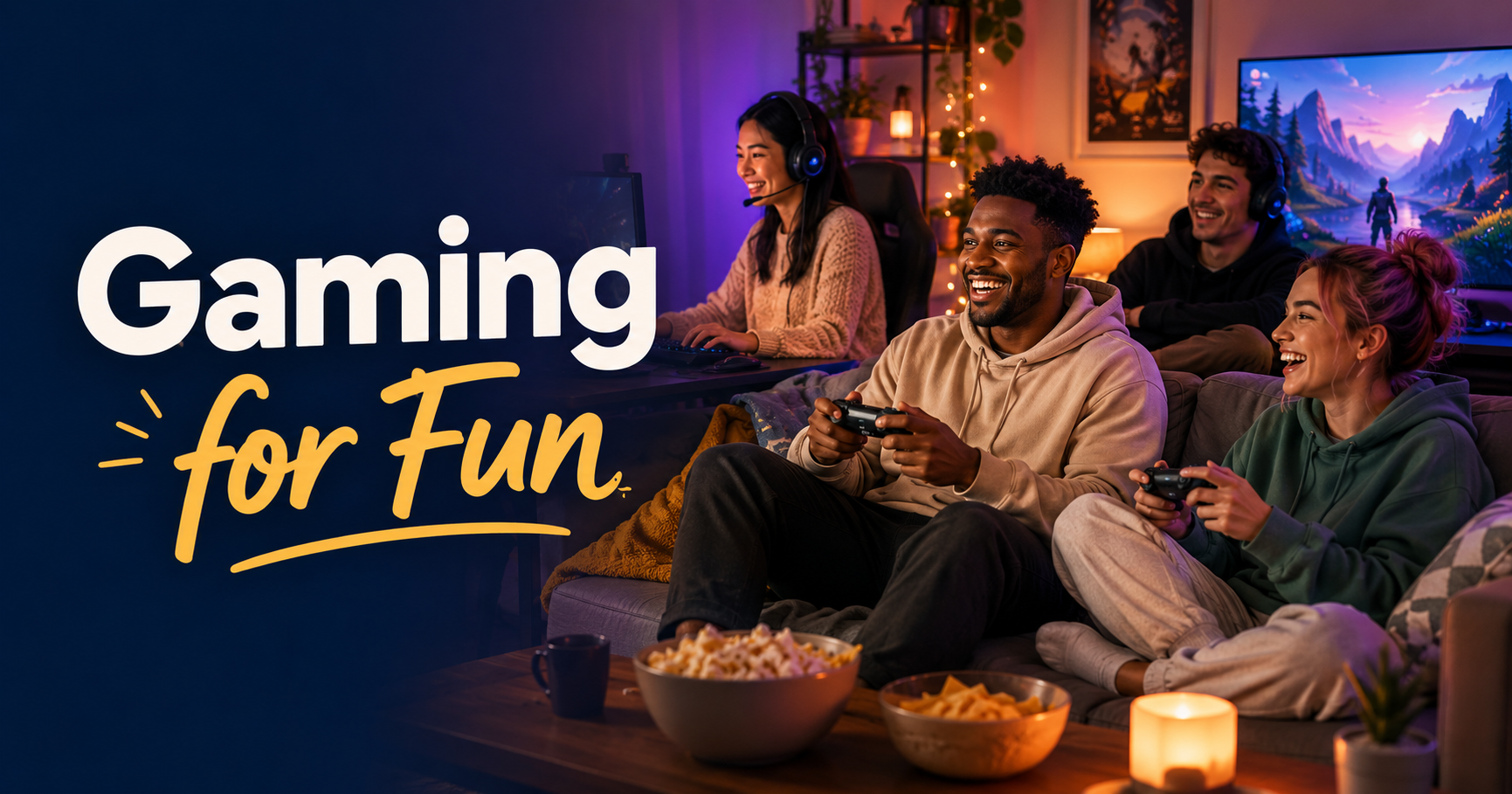
Gaming for Fun: Play Without the Pressure


Gaming for Fun: Why You Don't Need to Turn Gaming Into a Job
Gaming can be competitive, social, challenging, creative, relaxing, or completely ridiculous. It can also be something much simpler: a hobby you do for fun. For new players, returning gamers, and people who have been playing for years, gaming for fun means choosing enjoyment over pressure.

Modern games give players plenty to chase. There are ranks, achievements, trophies, battle passes, daily challenges, seasonal events, statistics, leaderboards, and limited-time rewards. Streaming and social media add another layer by putting highly skilled players and optimized strategies in front of us every day. Gaming for fun means none of those things have to define how you play.
What Does Gaming for Fun Actually Mean?
Gaming for fun means enjoyment is your main reason for playing. That can mean competing with friends, exploring a story, building a city, racing cars, collecting achievements, playing on easy mode, or spending two hours accomplishing almost nothing while laughing in voice chat. The experience matters more than meeting someone else's definition of success.
One player might spend Saturday night trying to defeat a difficult boss. Another might build houses in a simulation game. Someone else might play several rounds of a shooter with friends after work. All three are gaming for recreation, and all three approaches fit the idea of gaming for fun.
Playing recreationally does not mean you cannot care about winning or improving. You can play ranked modes, finish difficult games, collect every achievement, spend hundreds of hours in one title, or follow competitive gaming. If those things are enjoyable, they still fit.
The difference is what drives you. If ranking up is fun, rank up. If collecting every achievement is fun, collect them. If you finish half a story and decide another game sounds better, move on.
Gaming for Fun by the Numbers
Gaming for fun is far broader than professional esports, livestreaming, and competitive play. The Entertainment Software Association's 2026 Essential Facts report found that 67% of Americans ages 5 through 90 play video games for at least one hour per week. That represents more than 212 million people, and the average U.S. player is 37 years old.
The same report found that relaxation and enjoyment are major reasons adults play. Those figures help explain why recreational gaming continues to appeal to such a wide range of people.
| Gaming statistic | Figure |
|---|---|
| Americans ages 5-90 who play at least one hour per week | 67% |
| Estimated number of U.S. players | More than 212 million |
| Average U.S. player age | 37 |
| Adults who play to pass time or relax | 66% |
| Adults who play to have fun | 66% |
| Adults who play to use their brain or keep their mind sharp | 32% |
Source: Entertainment Software Association, 2026 Essential Facts About the U.S. Video Game Industry, released June 3, 2026.
Those numbers support a simple point. Gaming does not need to become a career, competition, or public performance to have value. For millions of people, gaming for fun is already the point.
Why Gaming for Fun Can Start Feeling Like Work
Many modern games contain systems meant to give players reasons to return. Daily challenges, battle passes, player levels, ranked seasons, login rewards, limited-time events, achievement systems, and item collections can all make progression more satisfying. The problem begins when progression replaces entertainment.
There is a big difference between logging in because you feel like playing and logging in because you feel obligated to finish a daily challenge. Gaming for fun becomes harder when every session starts feeling like a checklist. A useful test is asking yourself whether you would still play the game tonight if there were no reward attached.
If the answer keeps being no, taking a break may be more enjoyable than forcing yourself through another session. You do not lose your gamer card for ignoring a daily objective. Sometimes the healthiest choice for your hobby is simply playing something else.
Battle Passes Can Create Pressure
A battle pass typically gives players rewards for gaining levels or completing objectives during a set period. Some people love that structure because it gives each session a clear goal. Others start to feel pressured after paying for the pass and seeing the deadline draw closer.
Missing several days can start to feel like losing value on something already purchased. That is where gaming for fun can quietly turn into gaming from obligation. You are allowed to skip a battle pass, leave one unfinished, or ignore the system completely.
Competitive Gaming for Fun Is Still Gaming for Fun
Competitive gaming can be exciting. Winning a close match, improving your rank, learning better strategies, and becoming more skilled can provide a strong sense of accomplishment. Competitive gaming for fun works when the challenge itself is entertaining rather than stressful.
Ranked modes often place players into divisions, skill ratings, matchmaking ratings, competitive tiers, or seasonal ranks. Some people enjoy that structure, while others prefer the same game in casual matches. Neither approach is more legitimate.
You can lose several matches and still have a good night. You can finish a season at a lower rank than expected and still improve. Gaming for fun does not require every scoreboard to end in your favor.
You Are Allowed to Be Average
Online gaming makes comparison easy. A person with 3,000 hours, specialized equipment, years of experience, detailed map knowledge, and practiced mechanics should probably outperform someone with 40 hours. That gap is normal.
You do not need to catch them. You can remain an average player forever and still get full entertainment value from gaming. Gaming skill is not a membership requirement.
For new gamers, this matters a lot. Learning controls, maps, timing, game systems, and movement takes time. Returning gamers may also feel rusty after months or years away, but gaming for fun gives both groups room to learn without treating every mistake like failure.
Fun Looks Different for Different Gamers
There is no single version of gaming for fun because people enjoy different parts of the hobby. Some players care about story, some enjoy competition, and others would rather spend the night building something that serves absolutely no practical purpose. That variety is part of what makes gaming appealing.
Story Players
Some players care most about characters, fictional worlds, exploration, and narrative. They may choose an easier difficulty so combat does not interrupt the story they want to experience. Games such as The Elder Scrolls V: Skyrim can appeal to players who enjoy exploring at their own pace.
Social Players
For social gamers, the game can become almost secondary. They may spend more time talking and laughing with friends than completing objectives. A failed mission can become the funniest moment of the night.
Challenge Players
Some gamers enjoy difficult experiences. Losing repeatedly to a boss, learning its patterns, changing strategies, and finally winning may be exactly what makes gaming for fun satisfying to them. Difficulty itself can be part of the entertainment.
Builders and Explorers
Other players prefer creating cities, houses, factories, farms, characters, or entire worlds. Explorers might ignore the main mission for hours while searching caves, collecting items, reading lore, or seeing what lies beyond the next hill. Open-world games such as Fallout 4 give players plenty of room to play that way.
Casual Competitors
Some people enjoy competition without caring much about long-term ranking. Winning feels good, losing is fine, and then they queue for another match. That is another perfectly valid way to play for fun.
Playing on Easy Mode Still Counts
Difficulty settings sometimes create pointless arguments in gaming communities. Gaming for fun means choosing the setting that gives you the experience you actually want. If a developer includes Easy, Normal, Hard, or similar options, those settings are part of the game.
Difficulty can affect enemy health, damage received, combat speed, available resources, timing windows, artificial intelligence behavior, and assistance features. One player may choose an easier setting to focus on the story, while another player may select the hardest available setting. Both are using the options the game provides.
Neither player owes anyone an explanation. The best difficulty is the one that makes the game enjoyable for you. Gaming for fun is about the experience, not impressing strangers.
Gaming for Fun Does Not Require Finishing Every Game
Buying a game does not create a contract requiring you to complete it. Sometimes a game starts well and becomes repetitive. Sometimes your interests change, another title sounds more appealing, or you stop having fun.
The money has already been spent. Playing another 20 hours won't restore it, and your time also has value. Gaming for fun means permitting yourself to move on when something no longer holds your interest.
Ask yourself three questions:
- Am I looking forward to playing this?
- Am I having fun once I start?
- Would I rather spend this time playing something else?
If the third answer keeps winning, moving on makes sense. Your gaming backlog is not homework, and your library is not waiting to grade you.
Gaming With Friends Can Change the Experience
Gaming for fun has a strong social side. The ESA's 2025 Essential Facts report found that 55% of U.S. players ages 8 through 90 played video games with others at least weekly. It also found that 49% said games helped them stay connected with friends and family.
Multiplayer gaming can include cooperative campaigns, competitive matches, survival games, MMOs, racing games, sports games, party games, and sandbox games. You do not need a huge group to enjoy any of them. Two friends playing together once a week still counts as social gaming.
Some of the best multiplayer memories come from failure. The terrible strategy that somehow worked, the accidental team kills, the vehicle driven directly off a cliff, or the mission everyone failed while laughing can become more memorable than a clean victory. Gaming for fun sometimes means remembering the disaster more fondly than the win.
Watch Your In-Game Spending
Gaming for fun can get expensive if purchases go unchecked. The Entertainment Software Rating Board uses the label “In-Game Purchases” for games that offer digital goods or services purchased with real-world currency. These can include skins, virtual currency, bonus content, subscriptions, season passes, and upgrades.
The ESRB also uses “In-Game Purchases (Includes Random Items)” for purchases where the player does not know the exact reward before buying. Those systems can make it easy to spend more than intended if you stop thinking in real dollars.
A few habits can help keep spending under control:
- Set a monthly gaming budget.
- Avoid buying something solely from fear of missing it.
- Wait before purchasing expensive cosmetic items.
- Convert virtual currency back into real dollars before deciding whether something feels worth the price.
- Check your transaction history regularly.
A $10 purchase may seem small on its own. Repeated purchases can add up to a much larger expense, and gaming for fun should not create unnecessary financial stress.
If you are shopping for hardware, it also helps to read reviews before spending money. For example, my GameSir Super Nova Controller Review looks at one lower-cost controller option for players comparing accessories.
Protect Your Privacy While Gaming Online
Multiplayer games can connect you with people you would never meet offline. The ESRB's “Users Interact” notice identifies games that may allow player communication or user-generated content. That makes basic account security worth taking seriously.
Use a unique password, enable two-factor authentication when available, review privacy controls, and use block or mute tools as needed. Avoid usernames that reveal private information. Be careful about sharing your full name, home address, workplace, school, phone number, financial information, or account credentials.
You are also allowed to leave a toxic lobby. Muting someone is not admitting defeat. Gaming for fun means protecting the part of the hobby you actually enjoy.
Signs Gaming for Fun Is Becoming a Chore
One bad gaming session does not mean anything is wrong. Repeated patterns matter more, especially if you regularly feel that you have to log in, cannot miss a daily reward, must finish a battle pass because you paid for it, or consider an entire evening wasted because your rank dropped. Those feelings can be signs that the game has stopped serving its original purpose.
You do not necessarily need to stop gaming. Try changing what you are doing instead. Switch genres, leave ranked mode, play solo, find different teammates, lower the difficulty, ignore optional objectives, take several days away, or start another game.
Sometimes you are not tired of gaming. You are tired of that game. Gaming for fun becomes much easier when you permit yourself to make that distinction.
How to Keep Gaming for Fun From Feeling Like Work
Keeping gaming for fun enjoyable usually comes down to choosing games, goals, and routines that fit what you actually want to do. Do not choose games solely from popularity charts. Watch gameplay footage and pay attention to what players actually spend their time doing.
A game can be incredibly popular and still be a poor match for you. You are also allowed to ignore optional challenges, collections, achievements, and seasonal rewards when they stop being enjoyable. A menu full of objectives does not mean you need to complete all of them.
Rotating different types of games can also help. You might keep one story game, one multiplayer game, and one relaxing game installed at the same time. Switching between them can keep one title from becoming repetitive.
Gaming should also fit into your life rather than consume every part of it. Sleep, work, school, relationships, household responsibilities, and finances still matter. Gaming for fun does not need to occupy every free hour to count as a real hobby.
Common Mistakes Gamers Make
Chasing every trend is one of the easiest ways to spend money on games you do not actually enjoy. You do not need to play a title simply because everyone else is discussing it. Popularity does not guarantee that a game will match your interests.
Treating your backlog like unfinished work creates another problem. A collection of unplayed games is not a debt, and sales return often enough that your library does not need another purchase every time something goes on sale. Gaming for fun works better when your collection feels like a set of choices rather than obligations.
Other players should not choose your difficulty for you, and toxic groups do not deserve unlimited chances to ruin your evening. Finding different teammates can completely change how a multiplayer game feels. Progress is also not the only measure of a good session.
You might play for two hours and accomplish almost nothing. If you laughed the whole time, the session still worked. Gaming for fun does not require a progress bar to prove that your time was worthwhile.
Gaming for Fun Does Not Mean Gaming Without Goals
Goals themselves are not the problem. A gamer may love reaching Diamond rank, earning every achievement, finishing a 100-hour RPG, building a giant Minecraft project, learning a difficult boss fight, or completing a seasonal event. Those goals can make a game more rewarding.
The useful distinction is whether the goal adds enjoyment or replaces it. If chasing the goal is fun, keep going. If finishing it feels like clocking out of a shift, reconsider why you are chasing it.
Gaming for fun can include serious competition, long-term goals, difficult challenges, and personal improvement. It simply means those goals remain part of the entertainment rather than turning the hobby into an obligation.
FAQ
What Does Gaming for Fun Mean?
Gaming for fun means playing primarily for enjoyment rather than treating every session as a competition, obligation, or measure of productivity. You can still chase ranks, achievements, difficult bosses, and long-term goals. The deciding factor is whether those activities are enjoyable to you.
Do I Count as a Gamer if I Only Play Casually?
Yes. There is no minimum number of hours, required platform, skill level, or genre that determines whether someone plays video games. Casual players are still gamers.
Is Playing on Easy Mode Cheating?
No. A difficulty setting included by the developer is part of the game. Choose the setting that best matches your preferred experience.
Do I Need to Play Competitive Games?
No. Gaming includes story-driven games, simulations, puzzles, strategy games, RPGs, racing games, sandbox games, cooperative titles, and many other styles. Competitive gaming is one option among many.
Can Competitive Gaming Still Be Gaming for Fun?
Yes. Some people genuinely enjoy competing. If ranked matches, improvement, and testing your skills are entertaining to you, competitive gaming still fits the idea of gaming for fun.
Your Next Step
The next time you start a game, think about what you actually feel like doing that night. Maybe you want to chase a rank, continue a story, build something ridiculous with friends, lower the difficulty, or try something completely different. Any of those choices can make sense.
Gaming can include goals, competition, challenges, progression, and accomplishments. It can also just be fun. New gamers do not need to prove they belong, returning gamers do not need to catch up, and current gamers do not need to complete every challenge placed in front of them.
Gaming for fun means permitting yourself to choose the experience that makes your free time enjoyable. Play what you enjoy, at the pace you enjoy it, with the people you enjoy playing with. That is more than enough reason to keep playing.
Sources
Entertainment Software Association. “2026 Essential Facts About the U.S. Video Game Industry.” June 3, 2026.
https://www.theesa.com/resources/essential-facts-about-the-us-video-game-industry/2026-data/
Entertainment Software Association. “Two-Thirds of Americans Play Video Games Every Week.” June 3, 2026.
https://www.theesa.com/two-thirds-of-americans-play-video-games-every-week-according-tonew-report-from-the-entertainment-software-association/
Entertainment Software Association. “2025 Essential Facts About the U.S. Video Game Industry.” June 3, 2025.
https://www.theesa.com/resources/essential-facts-about-the-us-video-game-industry/2025-data/
Entertainment Software Rating Board. “Ratings Guide.” Accessed August 23, 2026.
https://www.esrb.org/ratings-guide/

I’m CyberD3m0n, a passionate gamer and live streamer who thrives on challenges and connection. Join me for epic gameplay, insightful reviews, and a fun journey as we conquer new adventures together!
Short Link: https://www.cyberdemon.xyz/9jyx
Short Link: Short Link
Join the Journey
Gaming isn’t just what I do—it’s who I am. Dive into my world, follow the adventure, and connect with me across every platform.
Connect with Me
CyberD3m0n
From Pixels to Purpose
Gaming isn't just what I do, it's who I am. Every challenge, every quest, every pixel has shaped my journey.
I’m CyberD3m0n, a passionate gamer and live streamer who thrives on challenges and connection. Join me for epic gameplay, insightful reviews, and a fun journey as we conquer new adventures together!
📺 Stream With Me:
YouTube |
Twitch |
Kick |
Rumble
🌐 Socials:
BlueSky |
Mastodon |
Facebook
🎮 Main Hub:
cyberd3m0nstream










Related Posts


Stay Informed With the Latest & Most Important News
Previous Post
Next Post









Advertisement