

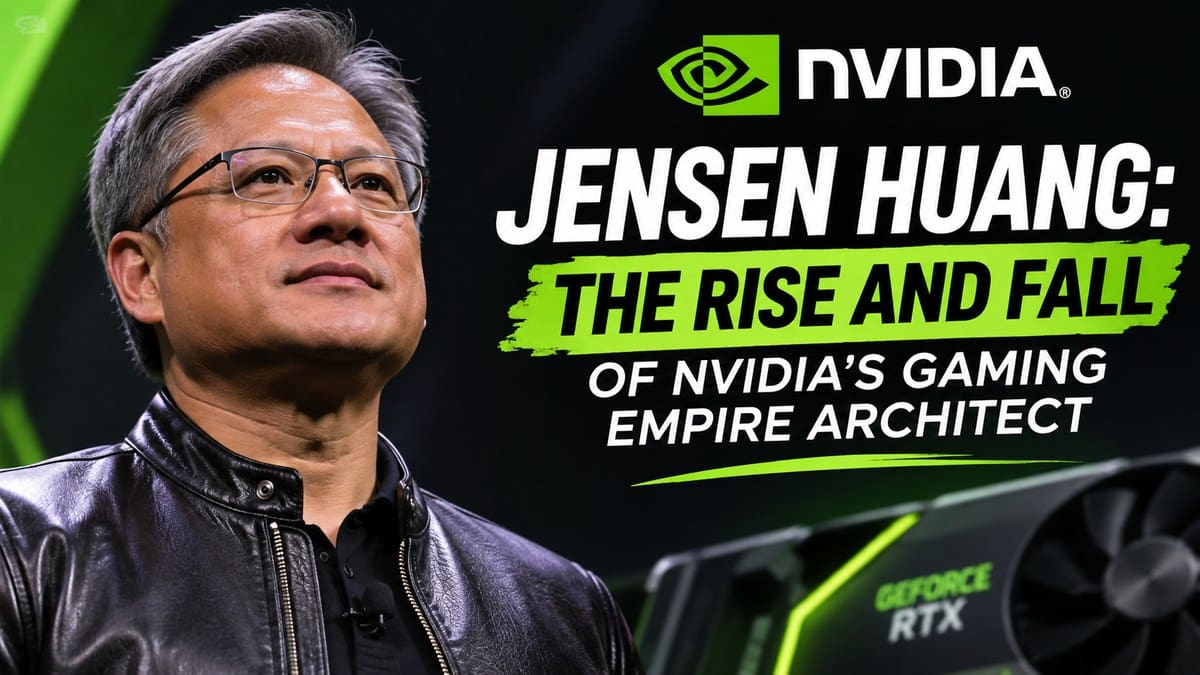
Jensen Huang: The Rise and Fall of NVIDIA’s Gaming Legacy
Jensen Huang spent more than three decades building NVIDIA into one of the most influential technology companies on the planet. For PC gamers, his name became closely associated with GeForce graphics cards, RTX technology, and the push for better gaming performance. His leadership helped transform computer graphics, but his remarkable career at NVIDIA came to an abrupt end in November 2026.
On November 12, NVIDIA announced that Huang had resigned as its CEO, president, and board member. His departure followed revelations about his personal conduct and reports of a suspected foreign intelligence operation. NVIDIA’s board had already announced an independent investigation into the security concerns.
The resignation ended a 33-year leadership tenure that helped establish NVIDIA as a major force in gaming and artificial intelligence. It raised questions about Huang’s legacy, the company’s corporate oversight, and the future of its consumer graphics business.
For gamers who have invested hundreds or thousands of dollars in NVIDIA hardware, the story extends well beyond a corporate scandal.
Jensen Huang: From Electrical Engineer to NVIDIA Founder
Jen-Hsun “Jensen” Huang was born in Taiwan in 1963 and later moved to the United States. He studied electrical engineering at Oregon State University, graduating in 1984, and earned a master’s degree from Stanford University in 1992. Before founding NVIDIA, he gained semiconductor industry experience at Advanced Micro Devices (AMD) and LSI Logic.
In April 1993, Huang co-founded NVIDIA alongside engineers Chris Malachowsky and Curtis Priem. The three entered a competitive graphics market where companies were racing to improve how computers displayed increasingly demanding 3D games.

NVIDIA’s early years were far from guaranteed success. Its first major graphics product, the NV1, struggled commercially, and the company faced strong competition from established manufacturers. The business eventually gained momentum through its RIVA graphics products and later the GeForce family.
Huang’s role was primarily that of an executive, strategist, and company leader. NVIDIA’s engineering teams developed the products, but Huang helped direct the investments and business decisions that brought those technologies to market.
That distinction matters. His leadership deserves recognition without overlooking the thousands of engineers, developers, researchers, and business professionals responsible for NVIDIA’s accomplishments.
How Jensen Huang Helped Shape Modern PC Gaming
For many PC gamers, NVIDIA’s history is closely connected to the evolution of graphics cards. As games became more demanding, the company’s GPUs helped make increasingly detailed environments, lighting effects, and complex 3D scenes possible.
One of NVIDIA’s most significant milestones arrived in 1999 with the GeForce 256. The company marketed it as the world’s first graphics processing unit, or GPU.
Dedicated 3D graphics accelerators existed before the GeForce 256. Nevertheless, NVIDIA’s design helped popularize the modern GPU concept by incorporating hardware-based transform and lighting calculations.
These capabilities reduced some of the graphics processing work previously handled by a computer’s central processor.
Throughout the 2000s, GeForce cards became a familiar choice among PC gaming enthusiasts. NVIDIA continued developing new GPU architectures, supporting modern graphics APIs, and competing against rival graphics manufacturers.
The GeForce 8800 GTX, introduced in 2006, became an important milestone through its unified shader architecture. That same year, NVIDIA introduced CUDA, a parallel-computing platform that would eventually help transform the company’s business.
CUDA was particularly significant for NVIDIA’s expansion beyond gaming. It allowed compatible graphics processors to perform computational tasks unrelated to displaying games.
The technology eventually became an important foundation for artificial intelligence research and development.
RTX, Ray Tracing, and DLSS
Another major development arrived in August 2018 when NVIDIA announced its GeForce RTX 20 series.
These graphics cards introduced dedicated hardware for accelerating real-time ray tracing in consumer gaming GPUs. Ray tracing simulates aspects of how light interacts with surfaces, allowing supported games to display more realistic reflections, shadows, and lighting.
NVIDIA introduced Deep Learning Super Sampling, commonly known as DLSS, alongside the RTX generation.
DLSS uses AI-based image reconstruction techniques to improve performance by rendering games at a lower internal resolution and reconstructing the final image. Later versions expanded the technology with improved reconstruction, frame generation, and additional rendering capabilities.
These features became increasingly important as PC games demanded more processing resources at higher resolutions.
Ray tracing and DLSS were not without tradeoffs. Ray tracing can impose substantial performance costs, and individual DLSS features depend on game support and compatible hardware. Image quality and performance gains can vary between titles and settings.
Still, their introduction marked an important shift in how graphics hardware and software worked together.
Under Huang’s leadership, NVIDIA helped establish AI-assisted rendering as a major part of modern PC gaming.
The Growing Cost of NVIDIA Graphics Cards
NVIDIA’s technological achievements have been accompanied by questions about graphics card pricing.
As GPUs became more sophisticated, high-end GeForce products increasingly carried prices that placed them beyond some consumers’ budgets.
In January 2025, NVIDIA announced the GeForce RTX 5090 with a starting price of $1,999 in the United States. The RTX 5080 launched with a starting price of $999.
For comparison, the company announced the RTX 5070 and RTX 5070 Ti at starting prices of $549 and $749, respectively.
These were official starting prices, not guarantees of retail availability at those amounts.
Actual prices can change with supply, demand, manufacturing costs, retailer markups, and graphics card configurations.
For gamers building a new PC, the difference between a $549 GPU and a $1,999 model is substantial. The more expensive option may deliver greater performance and features, but purchasing it is not financially practical for everyone.
NVIDIA’s pricing decisions deserve scrutiny, particularly when evaluating how its business strategy affects consumers.
At the same time, expensive products do not automatically establish illegal conduct or unfair competition. Development costs, manufacturing limitations, and market conditions can all contribute to pricing decisions.
Huang’s legacy includes the advanced hardware his company helped introduce and the criticism surrounding the cost of accessing its highest-performing products.
NVIDIA’s Transformation From Gaming to Artificial Intelligence
Perhaps Huang’s most consequential business achievement occurred outside traditional gaming.
Over time, NVIDIA expanded from a graphics hardware manufacturer into a leading supplier of computing infrastructure used for artificial intelligence, scientific research, and large-scale data processing.
GPUs proved useful for mathematical operations that could be performed simultaneously across many processing units. NVIDIA continued investing in hardware, networking, and software systems suited to these tasks.
As artificial intelligence development accelerated, demand for NVIDIA’s data center products increased dramatically.
According to NVIDIA’s financial disclosures, the company generated approximately $215.9 billion in revenue during fiscal 2026, representing 65% growth over the previous fiscal year.
The company’s November 17, 2026 earnings report showed that its growth continued.
For the third quarter of fiscal 2027, NVIDIA reported:
- Total quarterly revenue of $115.8 billion.
- Data center revenue of $107.6 billion.
- Total revenue growth of 103% compared with the same quarter a year earlier.
- Data center revenue growth of 110% year over year.
Data center operations represented approximately 93% of NVIDIA’s total quarterly revenue.
These figures demonstrate the scale of NVIDIA’s transformation.
A company once primarily associated with consumer graphics cards had become heavily dependent on enterprise computing and artificial intelligence.
Has NVIDIA Left PC Gamers Behind?
The growth of NVIDIA’s AI business raises a reasonable question: Is gaming still a priority?
There is no verified basis for claiming that NVIDIA has completely abandoned gaming. The company continued introducing GeForce products, improving DLSS, releasing drivers, and supporting technologies intended for game developers and consumers.
Its GeForce RTX 50 series demonstrates that NVIDIA was still developing consumer graphics technology during the expansion of its data center business.
Yet the financial difference between gaming and AI infrastructure is substantial.
NVIDIA’s data center products generate far more revenue than its gaming business. That creates legitimate questions about where management will concentrate investment and engineering resources.
The company’s financial results demonstrate a shift in revenue, but they do not establish that every consumer graphics decision was made at gaming’s expense.
For gamers, the most useful evidence will come from future products, performance improvements, pricing strategies, and software support.
The November 2026 Controversy Surrounding Jensen Huang
On November 8, 2026, NVIDIA’s board of directors announced an independent investigation following reports that Jensen Huang had been targeted by a foreign intelligence operation.
The board stated that independent directors and outside legal counsel would oversee the investigation.
Its initial public statement indicated that directors had no reason to believe NVIDIA’s confidential information or national security had been compromised.
The announcement followed reporting about Huang’s personal relationships, including allegations concerning a woman suspected by U.S. intelligence of connections to Chinese intelligence activities.
These allegations attracted attention partly because of NVIDIA’s importance to advanced computing and the ongoing dispute between the United States and China over semiconductor technology.
The public reporting did not establish that Huang knowingly assisted a foreign intelligence service or deliberately disclosed confidential information.
That is a necessary distinction when examining the controversy.
Huang’s Public Admission
On November 8, NVIDIA published a message from Huang acknowledging that he had been unfaithful to his wife.
In the statement, Huang apologized to his family, colleagues, business partners, and shareholders. He accepted responsibility for his personal actions and acknowledged the damage they caused.
He expressed support for the company’s investigation and committed to cooperating with it.
Huang’s admission established his own account of marital infidelity. It did not constitute an admission of espionage, illegal technology transfers, or other national-security offenses.
His personal conduct and the intelligence-related allegations must be evaluated separately.
For a chief executive responsible for a company with substantial national-security significance, questions about judgment and corporate oversight deserve serious examination. Those questions still require evidence before conclusions about illegal activity can be reached.
Jensen Huang Resigns After 33 Years at NVIDIA
On November 12, 2026, NVIDIA publicly announced that Huang had resigned as CEO, president, and a member of its board of directors.
A filing submitted to the U.S. Securities and Exchange Commission established that the board accepted his resignation on November 11, effective immediately.
The company appointed longtime Chief Financial Officer Colette Kress as interim CEO. Harvey Jones became chairman of the board.
The leadership change brought Huang’s uninterrupted tenure at the head of NVIDIA to an end.
It was an extraordinary development for a company whose public identity had been closely associated with its founder for more than three decades.
During his tenure, Huang became widely recognized for product presentations, major announcements, and his familiar black leather jacket.
His visibility helped make him one of the technology industry’s most recognizable executives.
However, NVIDIA’s long-term success depended on far more than one individual. The company had established research teams, experienced executives, commercial partnerships, and extensive engineering operations before Huang’s departure.
Would NVIDIA Bring Huang Back?
The question of a possible return emerged shortly after the resignation.
Reuters and the Associated Press reported that Huang was interested in returning if the company believed doing so would serve its interests.
During NVIDIA’s November 17 earnings call, board chairman Harvey Jones said the company did not intend to reinstate him as CEO.
NVIDIA continued operating under Kress as interim chief executive as the board pursued a permanent successor.
The resignation and leadership transition are confirmed events. Their legal and regulatory implications remain separate questions.
The company’s investigation and any subsequent official findings should be evaluated on their own merits.
NVIDIA’s China Business and National Security Concerns
The controversy surrounding Huang emerged against a larger dispute over advanced semiconductor technology.
The United States has imposed export restrictions on certain high-performance computing products intended for China. These restrictions reflect concerns that advanced AI processors could support military, intelligence, or other sensitive applications.
NVIDIA has advocated continued participation in international technology markets under applicable export rules.
Its commercial interests, national-security obligations, and relationships with international customers have made the company a subject of regulatory attention.
Reported concerns involving potential intermediaries and restricted technology transfers deserve investigation. Yet a government inquiry or allegation does not automatically demonstrate that NVIDIA or Huang violated export-control laws.
Establishing a violation requires evidence concerning specific products, destinations, licensing requirements, and the actions of the individuals or companies involved.
For PC gamers, these disputes may appear unrelated to purchasing a GeForce graphics card.
They demonstrate how much NVIDIA changed under Huang’s leadership. The company’s decisions now affect international technology policy, major computing infrastructure, and national-security debates.
What Jensen Huang’s Departure Means for PC Gamers
Huang’s resignation does not automatically mean NVIDIA will discontinue GeForce graphics cards or abandon the consumer market.
The company’s engineering teams, product technologies, software platforms, and existing commercial relationships remain part of the business.
Its November 2026 financial disclosures demonstrate that NVIDIA continued operating and generating substantial revenue following the leadership transition.
Nevertheless, a permanent CEO could influence the company’s long-term priorities.
For gamers, several areas deserve attention.
Future GeForce Graphics Cards
NVIDIA’s next GPU generations will reveal how much attention the company continues giving consumer graphics performance, hardware capabilities, and product affordability.
Announcements and actual product releases will provide stronger evidence than predictions about what the leadership transition might mean.
DLSS and RTX Development
DLSS, ray tracing, and other RTX features remain important parts of NVIDIA’s gaming ecosystem.
Gamers should watch whether future versions provide measurable improvements in supported titles, how widely developers adopt them, and which graphics card generations receive support.
Graphics Card Pricing
Competition from AMD and Intel remains relevant when evaluating NVIDIA’s consumer products.
Price-to-performance comparisons, memory capacity, energy efficiency, and actual gaming benchmarks matter more to most buyers than the identity of the CEO.
Future pricing decisions will offer insight into whether NVIDIA intends to serve a broad range of consumers or concentrate further on higher-priced products.
Continued Driver and Software Support
Reliable drivers, game compatibility, security updates, and software maintenance are fundamental to the ownership experience.
An executive transition does not establish that support will deteriorate. Gamers should evaluate the company’s actual releases and technical support record.
Jensen Huang’s Legacy: Success, Criticism, and Consequences
Jensen Huang helped establish NVIDIA as a major force in computer graphics and later artificial intelligence.
His leadership coincided with advances that changed how PC games are rendered, how developers use GPUs, and how businesses approach high-performance computing.
The GeForce family, CUDA, RTX, and DLSS are important parts of that history.
Yet Huang’s accomplishments do not place his conduct or business decisions beyond scrutiny.
NVIDIA’s premium graphics card pricing, growing dependence on data center revenue, corporate governance, and national-security responsibilities are legitimate subjects for independent journalism.
His departure adds a difficult chapter to an otherwise remarkable executive career.
Huang publicly acknowledged personal misconduct and resigned amid an investigation. Allegations involving foreign intelligence require additional evidence and should not be presented as proven criminal conduct.
An accurate assessment must recognize what he accomplished, what he admitted, what investigators have established, and what remains unresolved.
The Future of NVIDIA Without Jensen Huang
Jensen Huang’s departure marks the end of an important period in PC gaming and technology history.
He helped build a company whose graphics processors influenced generations of games and whose computing systems later became central to artificial intelligence.
NVIDIA remains a major supplier of gaming hardware, but its financial future is increasingly connected to AI infrastructure.
For gamers, the most important question is not whether the next CEO will match Huang’s public personality. It is whether NVIDIA will continue delivering competitive graphics cards, meaningful performance improvements, dependable software, and products that ordinary consumers can afford.
Huang’s achievements will remain part of PC gaming history. His resignation and the circumstances surrounding it will remain part of his public record.
The next chapter belongs to NVIDIA’s new leadership, its engineers, its competitors, and the customers who expect the company to keep improving the technology they use.
CyberD3m0n
From Pixels to Purpose
Gaming isn't just what I do, it's who I am. Every challenge, every quest, every pixel has shaped my journey.
I’m CyberD3m0n, a passionate gamer and live streamer who thrives on challenges and connection. Join me for epic gameplay, insightful reviews, and a fun journey as we conquer new adventures together!
📺 Stream With Me:
YouTube | Twitch | Kick | Rumble
🌐 Socials:
BlueSky | Mastodon | Facebook
🎮 Main Hub:
cyberd3m0nstream






Home » Forums » Jensen Huang: The Rise and Fall of NVIDIA’s Gaming Empire Architect
Tags: Artificial Intelligence DLSS gaming industry GeForce Graphics Cards Jensen Huang NVIDIA PC gaming RTX technology news
Jensen Huang helped transform NVIDIA and PC gaming. Following his November 2026 resignation, we examine his legacy, the controversies and GeForce’s future.
[See the full post at: Jensen Huang: The Rise and Fall of NVIDIA’s Gaming Empire Architect]