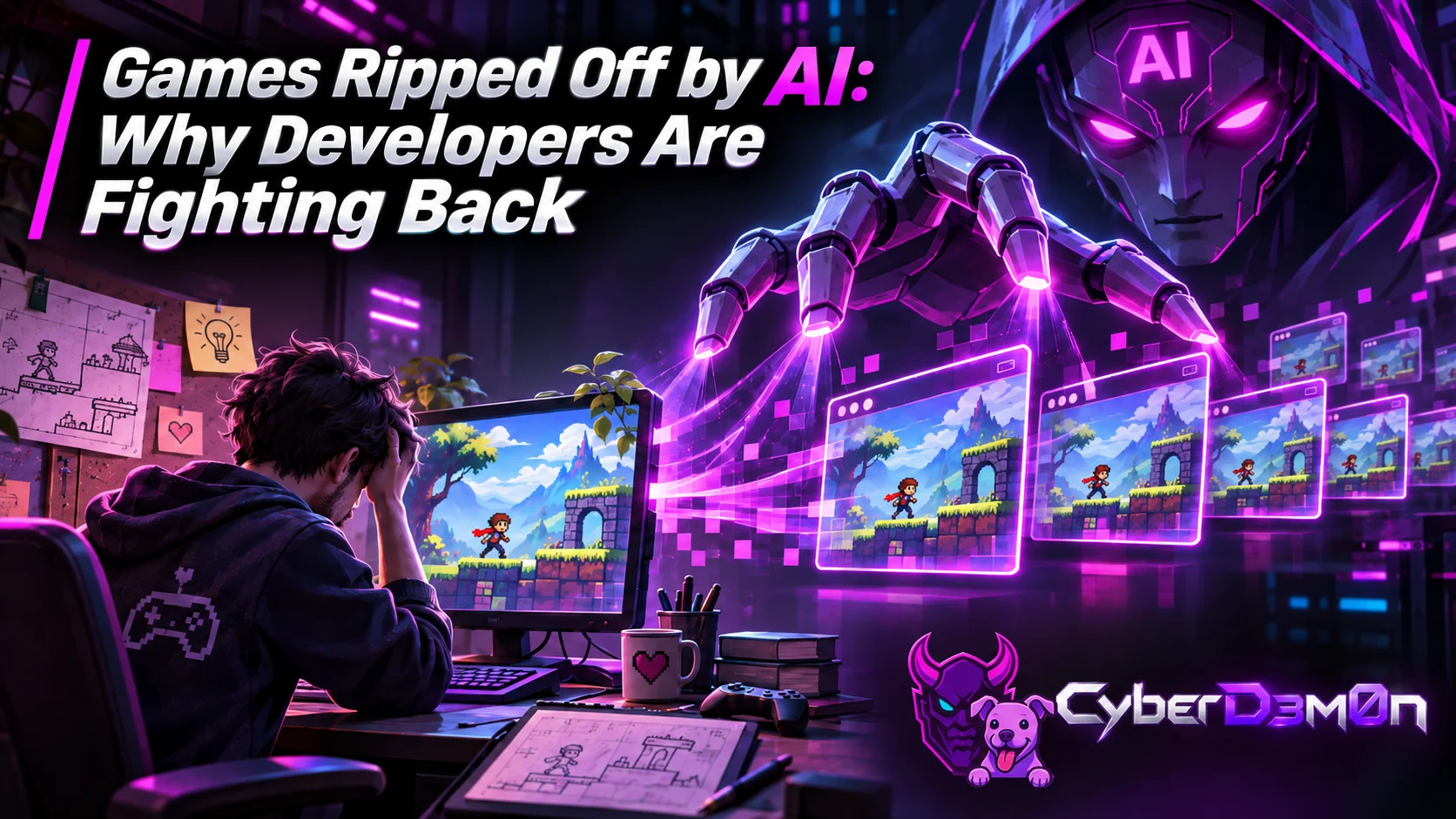
In October 2026, Digital Sun Games canceled plans for a widely accessible playtest of its upcoming title, ReVamp, citing fears of AI-assisted cloning. Other developers have raised similar concerns, while Valve has faced questions about protecting original games on Steam. Meanwhile, Anthropic has updated its Claude Code instructions to discourage recreating specific existing video games.
These developments highlight a difficult question for the industry: how can developers benefit from AI technology without making it easier for copycats to exploit their work? The answer could affect not only game creators but also the players who depend on independent studios for fresh and experimental gaming experiences.
What Are AI Game Clones?
AI game clones are games developed with artificial intelligence assistance that closely imitate existing or upcoming titles. They may reproduce familiar gameplay mechanics, visual presentations, progression systems, or combinations of features associated with another project. However, not every game sharing similar mechanics is necessarily a clone or an infringement.
Game developers have borrowed ideas from one another for decades. Platformers, survival games, battle royales, and farming simulators all contain mechanics that appear across multiple releases. The concern surrounding AI game cloning is primarily about the speed at which recognizable concepts can now be reproduced.
How Vibe Coding Accelerates Game Development
One technology at the center of the controversy is vibe coding. This development approach involves describing desired software behavior in everyday language and allowing AI systems to generate substantial portions of the code. Users can then request modifications, troubleshoot errors, and refine functionality through additional instructions.
Tools such as Claude Code can assist with programming tasks that previously required more direct technical work. Although the output still needs testing and improvement, AI assistance can make simple prototypes faster to develop. Those capabilities are useful for legitimate creators, but they can also accelerate the production of imitations.
A developer might spend months refining an unusual gameplay idea, only to see another creator reproduce its basic mechanics after watching a short video. The imitation may lack polish, but it can still compete for attention and potentially reach players before the original project is ready.
Why Speed Matters
The most significant difference between traditional cloning and AI-assisted cloning is the compressed development timeline. A distinctive mechanic that once required extensive manual programming may now be approximated with considerably less effort. This creates problems for developers whose games depend on a recognizable central concept.
Importantly, AI does not automatically transform copied ideas into commercially successful games. Quality, design, balancing, and long-term support still matter. Nevertheless, faster imitation introduces competition that original developers may have little time to prepare for.
1. AI Game Clones Are Forcing Studios to Cancel Public Playtests
One of the most visible examples comes from Digital Sun Games, the Spanish studio known for Moonlighter, Cataclismo, and The Mageseeker. The developer is currently working on ReVamp, an upcoming game that combines tower-defense mechanics with action and roguelike elements.
Digital Sun originally intended to provide a broad public playtest through Steam. However, on October 19, 2026, the studio announced that it would begin with a more limited program through its Discord community. The change was motivated by concerns that an unfinished build could be reverse-engineered or imitated and released commercially before the original game.
ReVamp Moves to Controlled Testing
The smaller Discord playtest was scheduled to begin on October 29, while Digital Sun expressed hope that a wider public test could happen around January 2027. The studio did not announce that ReVamp had already been cloned. Instead, it described a preventive decision based on recent reports involving other developers.
According to Video Games Chronicle’s October 20 report, Digital Sun believed releasing a large public build months before launch presented an unacceptable risk.
The decision demonstrates how AI cloning concerns can disrupt ordinary development practices. Public playtests help studios identify problems, evaluate gameplay systems, and build relationships with potential customers. Restricting them may provide additional control, but it also reduces opportunities for player feedback and early promotion.
Drunken Goddess Reflux Faces Similar Concerns
Digital Sun was not alone. Alliance Arts and developer Who’s You also withdrew plans for a public demonstration of Drunken Goddess Reflux ahead of Steam Next Fest in October 2026. The developers feared that publicly accessible material could help others reproduce the game’s presentation and mechanics before release.
Rather than distribute the planned demonstration widely, the team shifted toward controlled sessions. As Ars Technica reported, the situation reflects a growing reluctance among developers to share unfinished projects openly.
For players, these decisions could mean fewer early opportunities to experience upcoming games. For developers, they create a difficult choice between promoting their work and limiting the information available to potential imitators.
2. Original Game Ideas Can Be Copied Before Release
Some independent developers have already encountered remarkably fast imitations of their concepts. One widely discussed example involves developer and technical artist Freya Holmér, who shared footage of an experimental puzzle game in March 2026. The project featured falling blocks and a playfield that rotated as pieces were placed.
The unusual mechanic attracted substantial attention online. However, within approximately five hours, another creator had posted an AI-assisted imitation of the concept. Additional similar projects appeared afterward, creating an uncomfortable situation for Holmér before her original game was complete.
Freya Holmér’s Rotating Puzzle Game
The incident illustrates the risks of revealing an easily understandable gameplay concept. A short video can generate excitement and attract followers, but it can also provide enough information for someone else to attempt a playable recreation.
Holmér expressed frustration about the effect these imitations could have on developers’ willingness to share their progress. According to 404 Media’s July 2026 reporting, she later described the pressure created by seeing copies emerge while she was still developing the original experience.
There is an important distinction between recreating a visible mechanic and reproducing an entire game. The early imitations did not necessarily contain Holmér’s intended depth, progression, or finished design. Even so, their appearance demonstrated how quickly a concept could become associated with multiple competing projects.
Escape the Walls Attracts Rapid Imitations
Another reported example involves Escape the Walls, an incremental game built around punching through obstacles. After its developer shared footage online, similar projects began appearing across gaming platforms.
According to PC Gamer’s October 19 report, at least seven Roblox imitations and another on Steam appeared within approximately ten days.
The reports do not establish that every imitation involved copyright infringement. However, the pace of competing releases helps explain why developers are concerned about revealing original ideas too early.
3. Steam Could Become Harder for Indie Developers to Navigate
Steam is one of the most important marketplaces for independent PC developers. Its discovery features, wishlist system, community pages, and promotional events allow smaller studios to reach audiences without the marketing budgets of major publishers. However, competition for attention is already intense.
AI-assisted cloning could introduce additional challenges by making it easier to produce games that imitate successful or highly anticipated concepts. When similar titles appear close together, players may struggle to identify the original project or understand the differences between competing releases.
Why Steam Next Fest Matters
Steam Next Fest allows developers to distribute demonstrations, attract wishlists, and receive feedback before releasing their games. The event can provide valuable exposure for projects that might otherwise remain unnoticed. However, making gameplay publicly accessible can also reveal mechanics and design choices to potential imitators.
The October 2026 event reportedly featured more than 8,000 demonstrations. That figure illustrates the scale of competition, although it does not establish that AI cloning caused the increase. A larger catalog means that discoverability remains challenging regardless of which tools developers use.
If more developers follow Digital Sun’s example, public gaming events could become less useful for discovering experimental projects. Studios may favor private testing, restricted demonstrations, or shorter promotional windows instead of open community participation.
Cheap Imitations Can Create Consumer Confusion
Players unfamiliar with an upcoming project could encounter a similar-looking game first and assume it is connected to the original developer. Others might become less interested in a mechanic after seeing multiple competing versions. Neither outcome guarantees financial damage, but both represent reasonable concerns for smaller studios.
Original developers also face the burden of explaining which projects are authentic. Maintaining official websites, verified accounts, and recognizable branding can help, but those activities require time and resources that could otherwise support development.
4. Valve Is Facing Pressure to Protect Original Games
Valve has acknowledged concerns about AI game cloning, although its position has frustrated some observers. During an industry event in South Korea, Valve business representatives Tom Giardino and Marc Wilkinson were questioned about how Steam could respond to rapidly produced imitations.
According to Game Developer’s October 28 coverage, the representatives emphasized that Valve does not want to dictate which development tools creators are allowed to use. They also encouraged developers to create distinctive games and establish communities that recognize and support original projects.
Valve’s Approach Places Responsibility on Developers
The reasoning behind Valve’s approach is that polished games with recognizable identities and engaged communities are more difficult to replace with inexpensive imitations. A project featuring interconnected systems, original artwork, and carefully designed progression may offer substantially more value than a quickly assembled copy.
However, this approach has limitations. Developers should not necessarily have to make their games more complicated simply to discourage copycats. Straightforward mechanics can produce outstanding experiences, and originality is not determined by the number of systems a game contains.
Valve’s position also raises questions about the responsibilities of digital storefronts. When a marketplace profits from selling games, developers may reasonably expect procedures for addressing impersonation, misleading listings, or credible intellectual property complaints.
Reported Threats Add Another Dimension
During the discussion, a developer reportedly described receiving an email threatening to clone and release their game first unless payment was made. The account was reported in connection with the Valve event and should be understood as an allegation rather than evidence of a widespread practice.
If substantiated, such conduct would represent a more serious problem than ordinary competition. Using the threat of copying someone’s work to demand money raises concerns about coercion and potential criminal behavior.
5. AI Companies Are Introducing Restrictions on Game Recreation
AI providers are also beginning to address concerns about unauthorized game copying. In late October 2026, Anthropic confirmed that it had updated instructions for Claude Code using its Opus 5.5 model. The change was intended to discourage the recreation of specific existing video games.
Anthropic technical staff member Addy Osmani explained that the update was designed to prevent the tool from helping users reproduce someone else’s particular game. Original projects, games inspired by established genres, and titles using creators’ own designs and assets are still intended to remain supported.
Claude Code’s New Restrictions
According to Game Developer’s October 30 report, the new instructions discourage recreating an existing game even when a user attempts to describe the imitation as an original project.
The distinction is important because AI-assisted development is not inherently harmful. Programming assistants can help creators build prototypes, troubleshoot software, and learn unfamiliar techniques. Anthropic’s change attempts to discourage direct imitation without eliminating those legitimate uses.
Will the Restrictions Stop AI Game Clones?
The updated guidance represents a response to developer concerns, but it does not guarantee that AI-assisted cloning will disappear. Users may switch services, modify their requests, or build similar systems through other methods. AI models may also struggle to distinguish an unlawful recreation from a legitimate project sharing common genre conventions.
The broader challenge is creating effective safeguards without limiting creative freedom. Developers should still be able to build platformers, puzzle games, survival experiences, and other original projects using familiar design principles.
Are AI Game Clones Illegal?
Not every game that resembles another title violates copyright law. In the United States, copyright generally protects original creative expression rather than abstract ideas, systems, or methods of operation. That distinction is particularly important in gaming, where many titles use similar mechanics.
According to the U.S. Copyright Office, ideas themselves are not protected by copyright in the same way as their original expression. The agency also explains that certain creative elements of games may qualify for protection.
For example, reproducing protected artwork, music, dialogue, or source code can raise legal concerns. Using another company’s branding in a misleading manner may also introduce trademark issues. However, developing a new game around a familiar mechanic is not automatically unlawful.
AI does not change these basic distinctions. Whether a particular imitation infringes intellectual property rights depends on the material involved and the relevant legal circumstances.
Why AI Game Cloning Matters to Gamers
Although independent developers are experiencing the most immediate effects, the controversy also matters to players. Smaller studios frequently experiment with ideas that larger publishers consider too risky. Their willingness to explore unusual mechanics contributes to the diversity of available games.
If developers become reluctant to share prototypes, players could lose opportunities to discover promising projects early. Public testing programs might become more restrictive, while promotional events could provide fewer playable experiences.
Players may also encounter additional confusion when multiple games resemble an unreleased original. Identifying authentic studios and understanding which project introduced a particular concept could become more difficult.
How Players Can Support Original Developers
Gamers can help independent creators by paying attention to where a game comes from and supporting studios through official channels. They do not need to reject every AI-assisted project or assume that similar mechanics automatically indicate theft.
- Check official developer accounts: Verify the studio behind a game before purchasing or recommending it.
- Wishlist original projects: Supporting authentic Steam listings can help developers build visibility.
- Follow development updates: Official announcements provide context about a project’s history and progress.
- Report misleading listings: Use platform reporting tools when there is credible evidence of impersonation or stolen material.
- Support quality and originality: Reviews, recommendations, and community participation can help smaller studios reach new audiences.
These actions cannot eliminate game cloning, but they can help players distinguish established projects from potentially misleading imitations.
What Can the Gaming Industry Do About AI Game Clones?
Completely banning AI development tools would restrict legitimate creators without necessarily eliminating imitation. However, leaving developers to address every problem independently may also be insufficient. A more practical response would involve cooperation between storefronts, AI companies, and game studios.
Improve Reporting and Intellectual Property Reviews
Digital storefronts could establish clearer procedures for investigating credible allegations of infringement and impersonation. Developers should have a reasonable way to present evidence without assuming that every similar game deserves removal.
Provide Clearer AI Development Guidelines
AI providers could explain how their systems distinguish legitimate genre-based development from requests to reproduce specific protected games. Transparent rules may help creators understand the boundaries while allowing legitimate experimentation to continue.
Protect Early Development Builds
Studios may use limited playtests, private demonstrations, and staged release schedules to reduce unnecessary exposure. These measures involve trade-offs, particularly when broad public feedback is important for improving gameplay.
Ultimately, protecting original developers requires more than one technical solution. Better reporting systems, responsible AI policies, and strong communities could all contribute to a healthier environment for independent games.
Key Takeaways
- AI-assisted development can accelerate the creation of games that imitate existing or upcoming projects.
- Digital Sun restricted the initial ReVamp playtest over concerns about cloning and reverse engineering.
- Developers including Freya Holmér have experienced rapid imitations of publicly shared concepts.
- Valve has acknowledged the issue but has emphasized developer communities and distinctive game design.
- Anthropic has updated Claude Code guidance to discourage recreating specific existing games.
- Sharing gameplay mechanics does not automatically establish copyright infringement.
- Players can help original developers by supporting verified projects and reporting credible impersonation.
Frequently Asked Questions About AI Game Clones
What are AI game clones?
AI game clones are games created with artificial intelligence assistance that imitate existing or upcoming titles. They may resemble another project’s mechanics, visuals, or overall design, although similarity alone does not establish infringement.
Why are indie developers worried about AI cloning?
Independent developers fear that AI tools can make it easier for competitors to reproduce recognizable gameplay concepts before an original game launches. Early imitations could interfere with promotion, player interest, and commercial opportunities.
Why did Digital Sun cancel the public ReVamp playtest?
Digital Sun restricted its original Steam playtest plans because it was concerned about an unfinished build being reverse-engineered or cloned. The studio moved toward smaller Discord-based testing and expressed hope for wider access around January 2027.
Is Valve banning AI-generated games on Steam?
No blanket ban on AI-assisted game development was announced in the reporting discussed here. Valve has acknowledged cloning concerns while emphasizing that it does not want to dictate which development tools creators use.
Can Claude Code still be used to create video games?
Yes. Anthropic’s updated guidance is intended to discourage recreations of specific existing games while continuing to support original projects, established genres, and games based on users’ own designs and assets.
Are AI-generated game clones automatically illegal?
No. Copyright generally protects original creative expression rather than abstract gameplay ideas. Whether a particular imitation violates intellectual property rights depends on the material copied and the applicable law.
Conclusion: The Future of AI Game Clones and Indie Gaming
AI game clones have become more than a hypothetical concern for independent developers. Studios are changing public testing plans, creators are reconsidering how much gameplay they share, and technology companies are beginning to introduce restrictions on direct game recreation.
The challenge is finding a balance that protects original work without preventing legitimate AI-assisted development. Artificial intelligence can help talented creators build new experiences, but it should not become an excuse to exploit someone else’s unfinished project.
For gamers, the outcome matters because independent studios remain an important source of experimentation and creativity. Protecting their ability to develop and promote original titles will help preserve the variety of experiences that make gaming worth exploring.
The gaming industry’s future should reward developers who create something meaningful, not simply those who can reproduce another creator’s idea the fastest.
CyberD3m0n
From Pixels to Purpose
Gaming isn't just what I do, it's who I am. Every challenge, every quest, every pixel has shaped my journey.
I’m CyberD3m0n, a passionate gamer and live streamer who thrives on challenges and connection. Join me for epic gameplay, insightful reviews, and a fun journey as we conquer new adventures together!
📺 Stream With Me:
YouTube | Twitch | Kick | Rumble
🌐 Socials:
BlueSky | Mastodon | Facebook
🎮 Main Hub:
cyberd3m0nstream
Subscribe my Newsletter for new game blog posts, reviews, gaming tips & new photos. Let's stay updated with gaming community!